Choosing the right size dog bed is not always straightforward.
Different breeds have different builds, sleeping styles, and space needs. This guide provides specific sizing recommendations for popular breeds to help you get the perfect fit.
The Basic Rule
Measure your dog from nose to base of tail, then add 6 to 12 inches.
This gives room to stretch and change positions. But breed characteristics matter too.
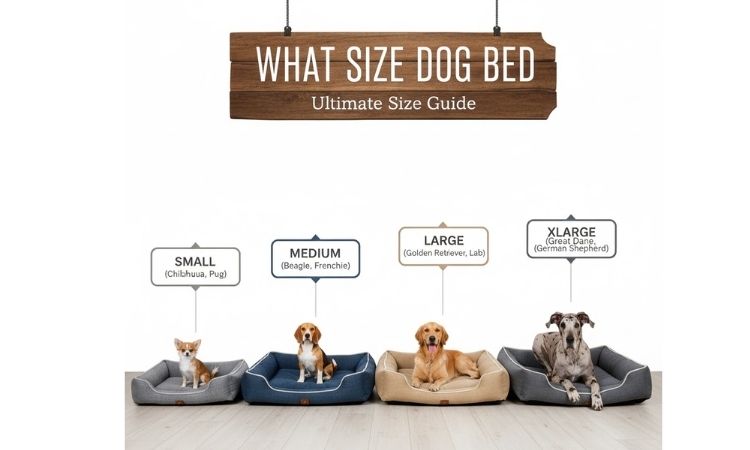
Dog Bed Sizes Explained
Sizing by Breed
Small Breeds (Under 25 lbs)
Chihuahua
- Weight: 3 to 6 lbs
- Recommended size: Small (18" to 22")
- Notes: Prefer cosy, enclosed beds. Often burrow under blankets. Bolstered beds provide security.
Yorkshire Terrier
- Weight: 4 to 7 lbs
- Recommended size: Small (18" to 22")
- Notes: Like soft, plush surfaces. Enjoy beds with raised edges.
Pomeranian
- Weight: 3 to 7 lbs
- Recommended size: Small (18" to 22")
- Notes: Fluffy coat means they can overheat. Consider beds with breathable materials.
Shih Tzu
- Weight: 9 to 16 lbs
- Recommended size: Small to Medium (20" to 26")
- Notes: Flat faced breed, needs good airflow. May prefer slightly larger beds for sprawling.
French Bulldog
- Weight: 16 to 28 lbs
- Recommended size: Medium (26" to 30")
- Notes: Wider body needs more space. Brachycephalic so avoid beds that restrict breathing. Low sided beds better.
Cavalier King Charles Spaniel
- Weight: 12 to 18 lbs
- Recommended size: Small to Medium (22" to 28")
- Notes: Love to curl up. Bolstered beds work well.
Pug
- Weight: 14 to 18 lbs
- Recommended size: Medium (24" to 28")
- Notes: Flat faced, needs airflow. Can overheat easily. Consider cooling beds in summer.
Miniature Dachshund
- Weight: 8 to 11 lbs
- Recommended size: Small to Medium (22" to 28")
- Notes: Long body needs extra length. Low entry important for back health.
Jack Russell Terrier
- Weight: 13 to 17 lbs
- Recommended size: Small to Medium (24" to 28")
- Notes: Active breed, may prefer open beds for quick movement.
Medium Breeds (25 to 50 lbs)
Beagle
- Weight: 20 to 30 lbs
- Recommended size: Medium (28" to 32")
- Notes: Like to curl up but also stretch. Versatile sizing needed.
Cocker Spaniel
- Weight: 24 to 30 lbs
- Recommended size: Medium (28" to 32")
- Notes: May overheat with thick coat. Moderate bolsters work well.
Border Collie
- Weight: 30 to 45 lbs
- Recommended size: Medium to Large (32" to 38")
- Notes: Active breed that stretches out. Need room to move.
Australian Shepherd
- Weight: 40 to 65 lbs
- Recommended size: Large (36" to 42")
- Notes: Despite medium height, they need large beds due to activity and sprawling.
English Bulldog
- Weight: 40 to 55 lbs
- Recommended size: Large (36" to 40")
- Notes: Wide, heavy body. Need sturdy beds with thick padding. Flat faced so airflow important.
Standard Dachshund
- Weight: 16 to 32 lbs
- Recommended size: Medium (28" to 34")
- Notes: Long body, short legs. Need length. Low entry essential for back protection.
Basset Hound
- Weight: 40 to 65 lbs
- Recommended size: Large (36" to 42")
- Notes: Heavy for their height. Need supportive foam. May drool heavily.
Staffordshire Bull Terrier
- Weight: 24 to 38 lbs
- Recommended size: Medium to Large (30" to 36")
- Notes: Muscular build. Need durable beds. Often like to curl up.
Whippet
- Weight: 25 to 40 lbs
- Recommended size: Medium to Large (32" to 38")
- Notes: Long, lean body needs length. Thin coat means they feel cold, may need warm beds.
Springer Spaniel
- Weight: 40 to 55 lbs
- Recommended size: Large (36" to 40")
- Notes: Active breed that sprawls. Need room to stretch.
Large Breeds (50 to 90 lbs)
Labrador Retriever
- Weight: 55 to 80 lbs
- Recommended size: Large to XL (40" to 48")
- Notes: Love to sprawl. Often overheat. Consider cooling options. Known chewers when young.
Golden Retriever
- Weight: 55 to 75 lbs
- Recommended size: Large to XL (40" to 48")
- Notes: Similar to Labs. Heavy shedders so washable beds essential. Like bolsters for chin resting.
German Shepherd
- Weight: 50 to 90 lbs
- Recommended size: Large to XL (42" to 50")
- Notes: Prone to hip dysplasia. Orthopaedic support essential. Long body needs adequate length.
Boxer
- Weight: 50 to 80 lbs
- Recommended size: Large to XL (40" to 48")
- Notes: Muscular and active. Thin coat, may need warmth in winter. Like to lean on bolsters.
Doberman
- Weight: 60 to 100 lbs
- Recommended size: XL (46" to 52")
- Notes: Tall and lean. Need length. Thin coat means they feel cold.
Standard Poodle
- Weight: 40 to 70 lbs
- Recommended size: Large (38" to 44")
- Notes: Tall but not heavy. Prefer comfortable, clean beds.
Vizsla
- Weight: 45 to 65 lbs
- Recommended size: Large (38" to 44")
- Notes: Lean, athletic build. Short coat, feel cold easily.
Weimaraner
- Weight: 55 to 90 lbs
- Recommended size: Large to XL (42" to 50")
- Notes: Tall and lean. Need length. May have separation anxiety, calming beds can help.
Husky
- Weight: 35 to 60 lbs
- Recommended size: Large (36" to 44")
- Notes: Thick coat means they overheat easily. Cooling beds recommended. Like to dig.
Rottweiler
- Weight: 80 to 135 lbs
- Recommended size: XL to Giant (48" to 54")
- Notes: Heavy and powerful. Need thick, supportive foam. Joint support important.
Extra Large and Giant Breeds (90+ lbs)
Great Dane
- Weight: 110 to 175 lbs
- Recommended size: Giant (54" to 60"+)
- Notes: Tallest breed. Need maximum length. Joint support critical. Prone to bloat so avoid eating near bed.
Mastiff
- Weight: 120 to 230 lbs
- Recommended size: Giant (54" to 60"+)
- Notes: Heaviest breed. Need thickest foam (7"+). Will flatten standard beds. Drool heavily.
Saint Bernard
- Weight: 120 to 180 lbs
- Recommended size: Giant (54" to 60")
- Notes: Massive and heavy. Need sturdy construction. Heavy droolers. May overheat.
Great Pyrenees
- Weight: 85 to 115 lbs
- Recommended size: XL to Giant (50" to 56")
- Notes: Thick double coat. Overheat easily. Consider cooling options.
Newfoundland
- Weight: 100 to 150 lbs
- Recommended size: Giant (52" to 58")
- Notes: Heavy with thick coat. Droolers. Need waterproof options. Can overheat.
Irish Wolfhound
- Weight: 105 to 180 lbs
- Recommended size: Giant (54" to 60"+)
- Notes: Tallest breed when standing. Need maximum length. Joint support essential.
Bernese Mountain Dog
- Weight: 70 to 115 lbs
- Recommended size: XL to Giant (48" to 54")
- Notes: Heavy boned. Thick coat means overheating risk. Joint issues common.
Leonberger
- Weight: 90 to 170 lbs
- Recommended size: Giant (52" to 58")
- Notes: Giant breed with thick coat. Need cooling and joint support.
Sleeping Style Affects Size
Curlers
Dogs who curl into a ball need less space than their stretched length suggests. Can often size down slightly.
Good bed types: Round donut beds, bolstered beds
Sprawlers
Dogs who sleep stretched out need full measurement plus extra inches. May need to size up.
Good bed types: Rectangular flat beds, mattress style
Side Sleepers
Need moderate space. Standard sizing usually works.
Good bed types: Bolstered on one side, flat
Chin Resters
Dogs who rest their head on edges need beds with sturdy bolsters at the right height.
Good bed types: Sofa style, sturdy bolster beds
When to Size Up
- Your dog consistently hangs off the edge
- They seem cramped when stretched
- They are still growing
- They have mobility issues (easier to position)
- Multiple sleeping positions used
When Smaller Is Fine
- Dog always curls tightly
- Small donut style bed being used
- Dog prefers cosy, enclosed feeling
- Using bed only for specific purposes (crate, travel)
Frequently Asked Questions
What if my dog is between sizes?
Choose the larger size. Dogs appreciate extra room and too small causes discomfort.
Does bed shape affect sizing?
Yes. Round beds need diameter measured. Rectangular beds use length and width. A 36" round bed has less sleeping space than a 36" x 28" rectangle.
Should I measure my puppy or adult size?
For puppies, estimate adult size based on breed and buy accordingly, or buy appropriately sized beds to replace as they grow.
My dog is mixed breed, how do I size?
Measure your actual dog rather than relying on breed charts. Mixed breeds vary widely.
Do bolsters reduce sleeping space?
Yes. A 40" bed with 4" bolsters has roughly 32" of actual sleeping space. Account for this.
The Bottom Line
Getting the right size bed matters for your dog's comfort. Use breed guidelines as starting points, but always measure your individual dog and consider their sleeping style.
Key takeaways:
- Measure nose to tail, add 6 to 12 inches
- Consider sleeping style (curler vs sprawler)
- Account for bolsters reducing space
- When in doubt, size up
Related Articles:
4.5
out of 5
24 global ratings
Top reviews
★★★★★5.0
Finally explains sizing in a way that makes sense
We’ve always eyeballed bed sizes and ended up with something too small for our Beagle. Using the nose-to-tail plus 8 inches rule and the Beagle section, we went with a 32" mattress style bed and it’s the first time he isn’t hanging off the edges. The mix of weight, breed notes, and sleeping style tips made it really straightforward.
Helpful
Thanks Emma, glad the Beagle sizing and measuring rule helped you dial in the right size.
★★★★★5.0
Spot on for our Frenchie
The French Bulldog section was exactly what we needed. Every pet store kept trying to sell us a small bed, but this guide pushed us to a medium with low sides and that was the right call. Our Frenchie can stretch out without his neck being cranked against tall bolsters.
Helpful
Appreciate that Michael, Frenchies really do benefit from that extra width and lower sides.
★★★★☆4.0
Helpful for our mixed breed Lab/Boxer
We have a Lab/Boxer mix and I was never sure whether to use Lab or Boxer guidelines. The article’s advice to measure our actual dog plus the large-to-XL suggestion for both breeds gave us confidence to size up. The only reason I didn’t give 5 stars is I wish there were a small section on common mixed combos.
Helpful
Thanks Sophia, that’s great feedback on mixed breeds and we’re glad the Lab/Boxer ranges still got you close.
★★★★★5.0
Great Dane sizing was accurate
Our Great Dane has outgrown every “XL” bed we’ve tried. The giant breed section here made it clear we needed to be looking at 54–60" beds, not the 48" ones labeled XL. We went with a 60" flat bed and for once he can actually stretch without his legs dangling off.
Helpful
Thank you Justin, happy to hear your Dane finally has the kind of space he actually needs.
★★★★★5.0
Perfect for our two small dogs sharing
We have a Chihuahua and a Yorkie who insist on sleeping together. Using the small breed recommendations and the tip to size up for multiple dogs, we chose a medium donut bed instead of two tiny ones. Both can curl up comfortably and still have a bit of spare room.
Helpful
Thanks Ava, pairing the small-breed sizing with a size up for sharing is exactly how we hoped people would use the guide.
★★★☆☆3.0
Decent guide but Whippet needed more length
The Whippet section suggested medium to large and the length seemed okay on paper, but our boy is very leggy even for a Whippet. The large bed we bought using the chart is just barely long enough when he fully stretches. I’d still recommend the guide, just say go to the top end of the range for extra lanky dogs.
Helpful
Appreciate the honest feedback, Ethan – and agreed, extra lanky Whippets do sometimes need that next size up.
★★★★★5.0
Explained bolsters vs actual sleeping space
The note about bolsters eating into usable space was something I’d never considered. We were about to buy a 36" bolster bed for our Cocker Spaniel, but factoring in the 4" bolsters we realized the sleep area would be too tight. We sized up and it fits her stretched-out position perfectly.
Helpful
Thanks Grace, we’re glad that bolster tip helped you avoid a bed that would have felt smaller than the label.
★★★★☆4.0
Good starting point for our Husky
The Husky section was on target about overheating and needing room to sprawl. The large bed size recommendation worked well. The only thing I’d add is a stronger nudge toward cooling beds or elevated options because ours definitely prefers anything with airflow.
Helpful
Thank you Noah, that’s a great point on emphasizing cooling options even more in the Husky section.
★★★★★5.0
Made crate pad sizing way less confusing
We were struggling to match our Mini Dachshund’s length with crate dimensions. The suggestion to prioritize length for long-backed breeds and keep the entry low helped a lot. We ended up with a slightly longer medium pad rather than a tiny small, and she can stretch without curling her spine awkwardly.
Helpful
Appreciate that Isabella, long-backed pups like Dachshunds definitely need that extra length.
★★★★★5.0
Great for choosing an orthopedic bed for our GSD
Our German Shepherd has early hip dysplasia, and we kept buying beds that were technically long enough but too narrow. The guide’s German Shepherd section and the reminder to size up for sprawlers pushed us into a wider XL mattress style bed. He’s finally able to lie on his side without being curled around the edges.
Helpful
Thanks William, we’re glad the GSD section and sprawler advice helped you choose something more comfortable for him.
★★★★☆4.0
Useful for our senior Pug
We used the Pug sizing guidelines and the note about overheating to switch from a high-sided donut bed to a low-to-medium bolster bed with more airflow. The size range given was accurate for her weight, but I wish there were a clearer callout for seniors that need a slightly bigger bed to change positions more easily.
Helpful
Thank you Abigail, that’s a smart tweak for senior Pugs and we’ll look at emphasizing mobility more in those notes.
★★★★★5.0
Spot on for our two Golden Retrievers
We have a pair of Goldens and wanted one large shared bed for our living room. The large-to-XL guidance plus the note about multiple dogs helped us choose a 48" rectangular bed. Both girls can sprawl or curl up without being on top of each other. Before this, we kept buying “large” beds that really only fit one dog.
Helpful
Thanks Jacob, two-Golden households definitely benefit from that extra width when sharing a bed.
★★★★★5.0
Bernese Mountain Dog sizing was very accurate
Our Berner is on the heavier side and the XL to Giant recommendation was right on the money. We ended up with a 50" orthopedic bed and I’m glad we didn’t go smaller. The guide also called out joint issues and overheating, which pushed us to pick something supportive with a breathable cover.
Helpful
Appreciate it Elizabeth, Berners do best when you treat them like the big, heavy dogs they are for bed sizing.
★★★☆☆3.0
Good ranges but our Aussie is between sizes
The Australian Shepherd section was helpful, but our girl is on the smaller side for the breed. The large bed we bought using the chart is just a bit bigger than she seems to need, though she does like the extra space. Not a bad thing, but if your dog is on the low end of the weight range, you might not need to go all the way to the top size.
Helpful
Thanks Andrew, totally fair point – for lighter Aussies, sticking to the smaller end of that range can work well.
★★★★★5.0
Really liked the sleeping style section
The breakdown of curlers vs sprawlers vs chin resters was honestly the most useful part for us. Our Boxer is technically in the large range, but he’s a total sprawler and head-rest guy. Using that section, we went up one size and chose a rectangular bolster bed. It matches how he actually sleeps instead of just his weight.
Helpful
Thank you Hannah, we’re glad the sleeping style section helped more than just the numbers.
★★★★☆4.0
Helped avoid buying a bed too small for our Rottie
Our Rottweiler was technically under 100 lbs, so we assumed an XL would be more than enough. The guide pointed out how dense and heavy Rotties are, and suggested XL to Giant. We went with a 52" bed and I’m glad we did, he uses every inch. I’d just love a printable cheat sheet of the tables.
Helpful
Appreciate it Joshua, that’s a great idea on a printable summary and we’re happy your Rottie got the room he needs.
★★★★★5.0
Chihuahua sizing and notes were spot on
We always bought the tiniest beds for our Chihuahua and she would still end up sleeping half on our pillows. The guide convinced us to go a little larger within the small range and choose a cosy, bolstered style. Now she can curl up without feeling crammed and still has room for her favorite blanket.
Helpful
Thanks Natalie, it’s surprising how much a properly sized small bed can change things for tiny dogs.
★★★★★5.0
Mixed breed rescue got a bed that actually fits
Our rescue is a total mystery mix, somewhere between a Spaniel and a small Lab. The article’s advice to ignore guesses and just measure nose-to-tail, plus add extra for sprawling, worked perfectly. We landed on a 40" bed and he finally has a dedicated spot that isn’t “whatever old cushion we have lying around.”
Helpful
Thank you Jonathan, measuring the actual dog is absolutely the way to go with mystery mixes like his.
★★★★☆4.0
Helpful but wish there were crate-specific notes
We followed the size recommendations for our Boston Terrier and the bed fits her fine in the living room. When we tried putting the same size into her crate, it was a tight squeeze against the crate walls. The general guidance is great, but a small section on how to size beds for crates vs open spaces would be a nice addition.
Helpful
Appreciate the suggestion, Lily – crate-specific sizing tips are a smart idea for a future update.
★★★★★5.0
Great for new owners with a growing puppy
We used this guide to plan ahead for our Labrador puppy. The section about puppies vs adult size helped us avoid buying a permanent bed too early. We grabbed a cheaper medium bed for now and are holding off on an XL orthopedic bed until he’s closer to his adult measurements.
Helpful
Thanks Henry, that’s exactly how we hope people use the guide with fast-growing pups.
★★★★★5.0
Saint Bernard sizing saved us from multiple returns
Our Saint Bernard is still young but already outgrowing beds. The Saint Bernard and giant breed sections gave clear dimensions instead of just “XL,” which every brand seems to define differently. We went straight to a 54" bed and I’m glad we skipped the in-between sizes that would have been a waste.
Helpful
Thank you Scarlett, giant-breed owners definitely benefit from looking at inches instead of labels.
★★★☆☆3.0
Vizsla recommendation worked but barely
Our male Vizsla is at the top end of the weight range and the large size recommendation is technically correct, but I wish the guide emphasized going wider as well as longer. He fits, but there’s not a ton of spare room when he lies on his side. Still, better than the too-small beds we had before.
Helpful
Thanks Dylan, that’s useful feedback – bigger male Vizslas definitely benefit from the wider end of that range.
★★★★★5.0
Good clarification on round vs rectangular beds
I didn’t realize how much less usable space there is in a round donut bed compared to a rectangular bed with the same measurement. Your example about a 36" round vs 36" x 28" rectangle helped us choose the right shape for our Cavalier King Charles, who likes to stretch out more than curl.
Helpful
Thank you Victoria, that round vs rectangular difference catches a lot of people out so we’re glad it helped.
★★★★★5.0
Leonberger finally has room to stretch
Our Leo was basically using a folded twin comforter because every bed we saw in person looked too small. The Leonberger section here, paired with the giant breed sizing, gave us the confidence to order a 56" bed online. It’s big, but so is he, and it’s the first time he’s been able to lie fully stretched without hanging off.
Helpful
Appreciate it Christian, we’re happy your Leo finally has something sized for his frame.