

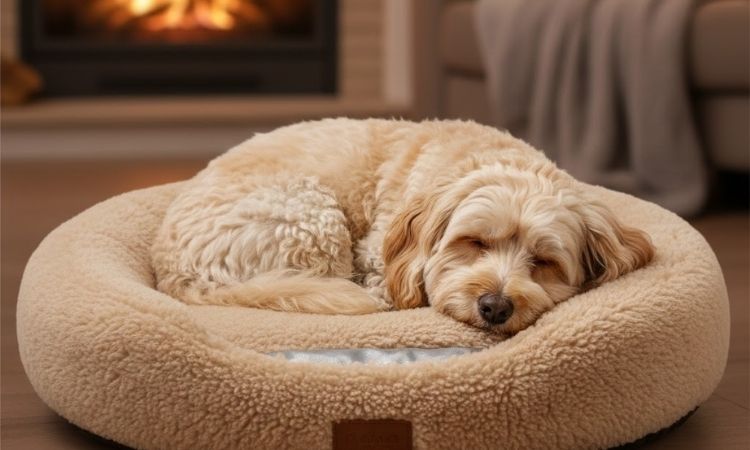
Self-warming dog beds offer a brilliant solution for dogs who get cold easily, all the warmth of a heated bed without electricity, cords, or running costs. These clever beds use your dog's own body heat, reflecting it back to keep them cosy. For dogs needing more heat, see our heated dog beds guide.
For dogs who shiver in winter, curl up tightly to conserve warmth, or constantly seek out sunny spots and warm laps, a self-warming bed can make a significant difference to their comfort and wellbeing.
How Do Self-Warming Dog Beds Work?
Self-warming beds use clever materials and design to capture and reflect your dog's natural body heat:
Reflective thermal layer - Most self-warming beds incorporate a metallic or reflective layer (often mylar-based) beneath the surface. This layer reflects radiated body heat back toward your dog rather than letting it escape into the floor.
Insulating materials - Quality self-warming beds include insulating layers that prevent heat from dissipating downward into cold floors.
Heat-retaining fill - Some beds use fill materials that retain warmth better than standard stuffing, creating a warm microclimate.
Enclosed designs - Cave beds, hooded beds, and high-sided designs trap warm air around your dog, complementing the reflective technology.
The result? A bed that warms up when your dog lies on it and stays warm without any electricity, batteries, or maintenance.
Which Dogs Benefit from Self-Warming Beds?
Self-warming beds aren't necessary for every dog, but certain dogs benefit significantly:
Small dogs - With high surface-area-to-volume ratios, small dogs lose body heat faster than large breeds. Chihuahuas, Yorkshire Terriers, Toy Poodles, and similar breeds often struggle to stay warm. See our small dog beds guide.
Single-coated breeds - Dogs without thick undercoats (like Whippets, Italian Greyhounds, Boxers, and Dalmatians) lack natural insulation.
Senior dogs - Older dogs often have reduced circulation and struggle to regulate body temperature effectively. See our best beds for senior dogs guide.
Lean/low body fat dogs - Dogs without much body fat (Greyhounds, sight hounds) have less natural insulation.
Hairless breeds - Chinese Crested, Xoloitzcuintli, and American Hairless Terriers obviously lack fur insulation.
Dogs with health issues - Certain conditions affect temperature regulation, making warmth crucial.
Puppies - Young puppies can't regulate temperature as effectively as adults. See our best beds for puppies guide.
Best Self-Warming Dog Beds: Our Top Picks
Best Overall: K&H Pet Products Self-Warming Pet Bed
K&H pioneered self-warming pet bed technology, and their flagship product remains the gold standard. The science works, the construction is quality, and dogs love it.
What we love:
- Genuine radiant heat reflection technology
- Soft quilted surface
- Non-slip bottom
- Machine washable
- Available in multiple sizes
- Affordable price point
- Proven track record
Sizing: Small (20" x 14"), Medium (24" x 24"), Large (32" x 32")
Best for: Most cold-sensitive dogs, reliable warmth on a budget
Best Premium Self-Warming: FurHaven ThermaNAP Self-Warming Blanket Bed
For dogs who like to burrow, this combination of self-warming technology and an attached blanket creates a cosy, warm cocoon.
What we love:
- Self-warming base plus attached blanket
- Perfect for burrowing dogs
- Ultra-soft plush material
- Non-slip bottom
- Machine washable cover
- Excellent warmth retention
Sizing: Small (17" x 22"), Medium (23" x 27"), Large (29" x 34")
Best for: Dogs who love to burrow under blankets, brachycephalic breeds, anxious dogs
Best Donut Style: Best Friends by Sheri Calming Donut
While marketed primarily as a calming bed, the faux fur construction and self-warming properties make this an excellent choice for cold dogs who also like to curl up. See our full donut dog beds guide and calming dog beds guide.
What we love:
- Self-warming through faux fur design
- Reflects body heat naturally
- Deep sides trap warm air
- Incredibly soft and cosy
- Calming for anxious dogs
- Machine washable
Sizing: 23" to 45" diameter options
Best for: Dogs who curl up tightly, anxious dogs who also get cold
Best Cave Style: Furhaven Snuggery Burrow Bed
The enclosed cave design combined with self-warming materials creates maximum warmth retention. Perfect for dogs who want to disappear into warmth. See our dog cave beds guide for more enclosed options.
What we love:
- Fully enclosed igloo shape
- Reflects and traps body heat
- Cosy microvelvet cover
- Orthopaedic foam base option
- Machine washable cover
- Great for small breeds
Sizing: 26" x 26" x 17"
Best for: Small dogs who love enclosed spaces and maximum warmth
Best for Large Dogs: Aspen Pet Self-Warming Bed
Large dogs get cold too, but finding self-warming beds in bigger sizes can be challenging. Aspen's offering caters to bigger breeds. See our large breed dog beds guide and extra large dog beds guide.
What we love:
- Available in larger sizes
- Mylar core reflects heat
- Plush corduroy and lambswool
- Machine washable
- Affordable for the size
Sizing: Up to 35" x 27"
Best for: Larger cold-sensitive dogs, senior large breeds
Best Orthopaedic Self-Warming: K&H Ortho Thermo-Bed
Combining self-warming technology with proper orthopaedic support, this bed serves senior dogs and those with joint issues who also need extra warmth. For more options, see our orthopedic dog beds guide.
What we love:
- Orthopaedic foam base
- Self-warming core
- Low profile for easy access
- Non-slip bottom
- Removable, washable cover
Sizing: Multiple sizes available
Best for: Senior dogs, dogs with arthritis, joint issues combined with cold sensitivity
Best Budget Option: PETCUTE Self-Warming Pet Pad
For those wanting to try self-warming technology without significant investment, this affordable pad delivers basic warmth reflection.
What we love:
- Very affordable
- Basic self-warming technology
- Multiple size options
- Machine washable
- Works on floors or inside other beds
Sizing: Multiple sizes from small to XL
What to consider: Less durable than premium options. Basic construction.
Best for: Budget buyers, adding warmth to existing beds, trying self-warming concept
Best Self-Warming Mat: Mora Pets Self-Heating Cat Pad
Designed for cats but perfectly sized for small dogs, this mat adds self-warming capability to any sleeping spot.
What we love:
- Thin profile works anywhere
- Place in crates, carriers, or beds
- Thermal core technology
- Machine washable
- Versatile use
Sizing: 20" x 24"
Best for: Small dogs, adding warmth to crates, supplementing existing beds
Self-Warming vs Electric Heated Beds
| Feature | Self-Warming | Electric Heated | Action |
|---|---|---|---|
| Heat source | Dog's body heat | Electrical element | |
| Warmth level | Moderate (5-10°F above ambient) | Adjustable (can be very warm) | |
| Running cost | None | Ongoing electricity | |
| Safety | No fire/shock risk | Requires supervision | |
| Portability | Fully portable | Limited by power access | |
| Best for | Mild cold, routine use | Extreme cold, specific needs |
When to Choose Self-Warming
Choose self-warming when:
- Your dog gets mildly cold but doesn't need intense heat
- Safety from electrical hazards is important
- You want a portable warming solution
- Running costs matter
- The bed will be used in areas without power
Choose electric heated when:
- Your dog has serious cold intolerance
- Room temperatures are extremely cold
- Your dog has a medical condition requiring warmth
- You need controllable, stronger heat
Maximising Self-Warming Bed Effectiveness
Placement Matters
- Keep away from draughty areas
- Place against walls rather than in room centres
- Avoid cold floors, use on carpet if possible
- Consider raised beds to avoid floor contact
Complement with Other Warmth Strategies
- Add a blanket on top for extra insulation
- Use in enclosed spaces (crates, dog houses)
- Combine with dog clothing for very cold dogs
- Position in sunny spots during the day
Choose Appropriate Design
- Cave and hooded beds trap more heat
- High-sided beds retain warmth better
- Enclosed designs beat open mats
- Fluffier materials insulate better
Signs Your Dog Is Cold
Watch for these indicators that a self-warming bed might help:
- Shivering or trembling
- Curling into tight balls when sleeping
- Seeking warm spots (sunny areas, near heaters)
- Reluctance to go outside in cold weather
- Burrowing under blankets
- Cold ears and paw pads
- Slow or stiff movement in cold conditions
- Whining or seeming uncomfortable
Frequently Asked Questions
Do self-warming dog beds actually work?
Yes, they work, but expectations should be reasonable. Self-warming beds typically raise the sleeping surface 5-10°F above ambient temperature by reflecting your dog's body heat. They won't create intense heat like electric pads, but they do make a noticeable difference for dogs who get cold.
Are self-warming beds safe?
Very safe. With no electricity, there's no risk of shock, fire, or burns. Dogs can't overheat on them because the warmth comes from their own body, if they get too warm, they simply move off. They're ideal for unsupervised use.
How warm do self-warming beds get?
The surface temperature rises 5-10°F above room temperature when your dog is on the bed. The warmth develops within minutes of your dog lying down and dissipates when they leave. It's gentle, natural warmth rather than active heating.
Can I use a self-warming bed in summer?
Yes, though your dog may choose not to use it. The self-warming effect is subtle enough that it won't cause overheating in warm weather, your dog will simply get off if they're too warm. Many dogs use them year-round.
Do self-warming beds need to be plugged in?
No, that's the key benefit. Self-warming beds require no electricity whatsoever. They work purely by reflecting your dog's natural body heat back toward them.
How do I wash a self-warming bed?
Most self-warming beds are machine washable. Use cold water on a gentle cycle to preserve the reflective layer. Tumble dry on low or air dry. Check manufacturer instructions, as some recommend removing inner components before washing.
Will a self-warming bed help my arthritic dog?
The gentle warmth can provide comfort for arthritic dogs, as warmth often soothes joint pain. However, if your dog has severe arthritis, combine a self-warming bed with proper orthopaedic support (memory foam) for best results.
Are self-warming beds good for puppies?
Yes, especially young puppies who can't regulate body temperature well. Self-warming beds are safer than electric options because there's no risk of overheating, cords to chew, or electrical hazards.
Caring for Self-Warming Beds
Regular Maintenance
- Vacuum weekly to remove hair and debris
- Spot clean accidents promptly
- Air out periodically
- Check for wear on the reflective layer
Washing
- Remove any separate components
- Use cold water and gentle cycle
- Mild detergent only
- Tumble dry on low or air dry
- Avoid high heat which can damage reflective materials
Longevity
The reflective layer in quality self-warming beds maintains effectiveness for years. Replace if:
- The reflective layer is visibly damaged
- The bed no longer seems to warm up
- The fill has compressed significantly
- Odours persist despite washing
Final Recommendations
For most dogs needing extra warmth, the K&H Pet Products Self-Warming Pet Bed offers proven technology at a reasonable price. It's the safe, reliable choice that works as advertised.
Dogs who love to burrow will appreciate the FurHaven ThermaNAP Self-Warming Blanket Bed, which combines self-warming tech with an attached blanket for maximum cosiness.
For cold-sensitive dogs who also need joint support, the K&H Ortho Thermo-Bed addresses both needs in one bed.
Self-warming beds won't replace electric heated beds for dogs with serious cold intolerance, but for most cold-sensitive dogs, they provide meaningful, safe warmth that makes a real difference to comfort, all without cords, electricity, or ongoing costs.
Browse All Self-Warming Beds on Amazon
For more intensive warming, see our guide to heated dog beds. Also explore calming dog beds and cave beds for dogs who like cosy, enclosed sleeping spots.
We’ve paused the on-page review box for now because we were getting too many spam submissions. If you’d like to share your experience, please send it through our contact form and I’ll add it manually. Thanks for understanding — genuine feedback really helps other dog owners. John Henry