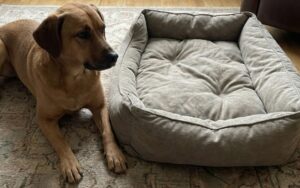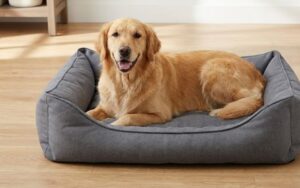

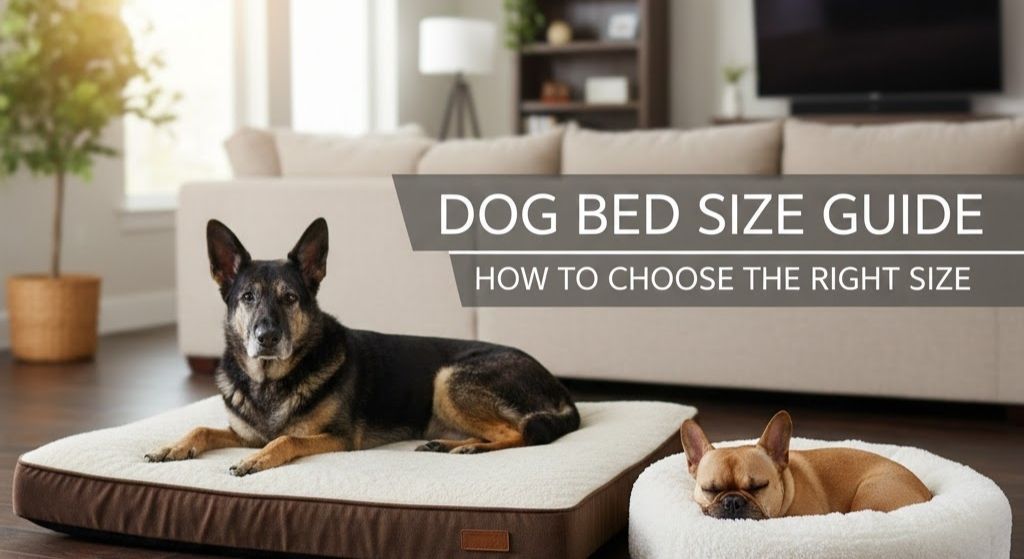
Buying the wrong size dog bed is one of the most common mistakes dog owners make.
Too small and your dog won't use it. Too big and they feel insecure. Getting it right matters more than most people realise.
With 6 dogs in our family—ranging from Molly (25 lb French Bulldog) to Charlie (85 lb German Shepherd)—I've learned exactly how to size dog beds properly.
This guide covers everything: how to measure your dog, size charts by breed, and tips for getting it right the first time.
Quick Size Guide
| Dog Weight | Typical Bed Size | Bed Dimensions | Action |
|---|---|---|---|
| Under 25 lbs | Small | 18" x 24" to 24" x 30" | |
| 25-50 lbs | Medium | 24" x 30" to 30" x 36" | |
| 50-75 lbs | Large | 30" x 36" to 36" x 42" | |
| 75-100 lbs | X-Large | 36" x 42" to 42" x 48" | |
| Over 100 lbs | XXL/Giant | 48" x 54" or larger |
Important: These are general guidelines. Your dog's sleeping style and body shape matter just as much as weight.
How to Measure Your Dog for a Bed
Step 1: Measure Length
- Wait until your dog is lying down, fully stretched out
- Measure from the tip of their nose to the base of their tail
- Add 6-12 inches for comfort
Example: Charlie measures 38 inches stretched out. He needs a bed at least 44-50 inches long.
Step 2: Measure Width
- With your dog lying on their side, measure from their back to their front paws
- Add 6-12 inches for comfort
Example: Charlie is about 18 inches wide. He needs a bed at least 24-30 inches wide.
Step 3: Consider Height (For Bolster Beds)
If you're buying a bolster or sofa-style bed:
- Measure from the floor to your dog's shoulder when lying down
- Bolsters should be high enough to rest their chin but low enough to step over easily
Sleeping Style Matters
How your dog sleeps affects what size they need:
Sprawlers
Description: Legs extended, takes up maximum space Size needed: Larger than measurements suggest Recommendation: Size UP
Dogs like Max (our Labrador) sprawl out completely. They need the largest bed for their weight class.
Curlers
Description: Curled in a ball, nose to tail Size needed: Can use slightly smaller beds Recommendation: Standard size or donut beds
Some dogs curl up tight when sleeping. They can use smaller beds than their stretched measurements suggest.
Chin-Resters
Description: Likes to rest chin on edge or pillow Size needed: Bolster or headrest beds Recommendation: Consider bed style, not just size
Lucy (Golden Retriever) always rests her chin on the bolster. She needs a bed with raised edges, not just the right dimensions.
Nesters
Description: Digs and arranges bed before lying down Size needed: Beds with extra material Recommendation: Donut beds or beds with loose fabric
Bella (Golden Retriever) nests for 5 minutes before settling. She needs a bed that accommodates this behaviour.
Size Guide by Breed
Small Breeds (Under 25 lbs)
| Breed | Typical Weight | Recommended Size | Action |
|---|---|---|---|
| Chihuahua | 3-6 lbs | Small (18-24") | |
| Yorkshire Terrier | 4-7 lbs | Small (18-24") | |
| Pomeranian | 3-7 lbs | Small (18-24") | |
| French Bulldog | 20-28 lbs | Small-Medium (24-28") | |
| Cavalier King Charles | 12-18 lbs | Small (22-26") | |
| Shih Tzu | 9-16 lbs | Small (22-26") | |
| Dachshund | 16-32 lbs | Small-Medium (24-30") | |
| Pug | 14-18 lbs | Small (22-26") |
Tip: Small dogs often prefer snug, enclosed beds. Don't size up too much—they like feeling secure.
Read more: Best Beds for French Bulldogs
Medium Breeds (25-50 lbs)
| Breed | Typical Weight | Recommended Size | Action |
|---|---|---|---|
| Beagle | 20-30 lbs | Medium (28-32") | |
| Cocker Spaniel | 25-35 lbs | Medium (28-32") | |
| Border Collie | 30-45 lbs | Medium-Large (30-36") | |
| Bulldog | 40-50 lbs | Medium-Large (32-36") | |
| Australian Shepherd | 40-65 lbs | Large (34-40") | |
| Springer Spaniel | 40-50 lbs | Medium-Large (32-36") | |
| Basset Hound | 40-65 lbs | Large (34-38") | |
| Corgi | 25-30 lbs | Medium (28-32") |
Tip: Medium breeds vary widely. Always measure—a muscular Bulldog needs more space than a lean Border Collie of similar weight.
Large Breeds (50-75 lbs)
| Breed | Typical Weight | Recommended Size | Action |
|---|---|---|---|
| Labrador Retriever | 55-80 lbs | Large-XL (36-44") | |
| Golden Retriever | 55-75 lbs | Large-XL (36-44") | |
| German Shepherd | 65-90 lbs | XL (40-48") | |
| Boxer | 55-70 lbs | Large-XL (36-42") | |
| Doberman | 60-100 lbs | XL (40-48") | |
| Husky | 35-60 lbs | Large (34-40") | |
| Pitbull | 30-65 lbs | Large (34-40") | |
| Standard Poodle | 45-70 lbs | Large (36-42") |
Tip: Large breeds benefit from orthopedic support. Don't just consider size—consider foam thickness too.
Read more: Best Beds for Labradors Read more: Best Beds for Golden Retrievers Read more: Best Beds for German Shepherds
Giant Breeds (Over 75 lbs)
| Breed | Typical Weight | Typical Weight | Action |
|---|---|---|---|
| Great Dane | 110-175 lbs | Giant (52-60"+) | |
| Mastiff | 120-230 lbs | Giant (54-60"+) | |
| Saint Bernard | 120-180 lbs | Giant (52-60"+) | |
| Bernese Mountain Dog | 70-115 lbs | XL-Giant (44-52") | |
| Irish Wolfhound | 105-180 lbs | Giant (52-60"+) | |
| Newfoundland | 100-150 lbs | Giant (48-54") | |
| Great Pyrenees | 85-115 lbs | XL-Giant (44-52") | |
| Rottweiler | 80-135 lbs | XL (42-48") |
Tip: Giant breeds need thick foam (7+ inches) that won't compress. Standard beds flatten quickly under their weight.
Bed Size Chart by Dimensions
Small Beds
| Dimensions | Best For | Action |
|---|---|---|
| 18" x 22" | Toy breeds, puppies | |
| 20" x 24" | Small breeds under 15 lbs | |
| 22" x 26" | Small breeds 15-25 lbs | |
| 24" x 30" | Small-medium breeds, larger small dogs |
Medium Beds
| Dimensions | Best For | Action |
|---|---|---|
| 28" x 32" | Medium breeds 25-35 lbs | |
| 30" x 36" | Medium breeds 35-45 lbs | |
| 32" x 38" | Medium-large breeds, sprawlers |
Large Beds
| Dimensions | Best For | Action |
|---|---|---|
| 34" x 40" | Large breeds 50-65 lbs | |
| 36" x 42" | Large breeds 65-75 lbs | |
| 40" x 48" | Large breeds 75-85 lbs, sprawlers |
X-Large Beds
| Dimensions | Best For | Action |
|---|---|---|
| 42" x 48" | X-large breeds 85-100 lbs | |
| 44" x 52" | X-large breeds, multiple dogs | |
| 48" x 54" | Large sprawlers, giant breeds |
Giant/XXL Beds
| Dimensions | Best For | Action |
|---|---|---|
| 52" x 36" | Giant breeds | |
| 54" x 40" | Giant breeds, sprawlers | |
| 60" x 48" | Extra-large giant breeds, multiple dogs |
Our Dogs: Size Examples
Here's what sizes our 6 dogs use:
| Dog | Breed | Weight | Bed Size | Dimensions | Action |
|---|---|---|---|---|---|
| Charlie | German Shepherd | 85 lbs | XL | 48" x 30" | |
| Bella | Golden Retriever | 70 lbs | Large | 44" x 34" | |
| Lucy | Golden Retriever | 65 lbs | Large | 44" x 34" | |
| Bailey | Labrador | 75 lbs | Large | 40" x 26" | |
| Max | Labrador | 80 lbs | XL | 46" x 28" | |
| Molly | French Bulldog | 25 lbs | Small | 24" x 20" |
Note: Bailey and Max are similar weights, but Max is a sprawler who needs more space.
Common Sizing Mistakes
Mistake 1: Buying Based on Weight Alone
Weight matters, but so does body shape and sleeping style. A 60-pound lean Doberman needs different space than a 60-pound stocky Bulldog.
Solution: Always measure your dog lying down, not just check their weight.
Mistake 2: Sizing Down to Save Money
A bed that's too small won't get used. Your dog will sleep on the floor instead, and you've wasted money.
Solution: When in doubt, size UP. A slightly larger bed is fine; too small is useless.
Mistake 3: Not Considering Bolsters
Bolster beds have raised edges that reduce the interior sleeping space. A 36" x 42" bolster bed might only have 32" x 38" of actual sleeping area.
Solution: Check interior dimensions, not just exterior.
Mistake 4: Forgetting Puppies Grow
A bed that fits your 8-week-old puppy won't fit your 6-month-old puppy.
Solution: For puppies, either buy for adult size (and accept it'll be big initially) or buy a budget bed now and upgrade later.
Mistake 5: Assuming All Brands Size the Same
A "Large" from one brand might be "Medium" from another. There's no standardisation.
Solution: Always check actual dimensions, not just size labels.
Special Considerations
For Senior Dogs
Older dogs need:
- Low profile for easy access
- Larger size if they've become less flexible
- Orthopedic support for joint relief
Don't size down for seniors—they need room to find comfortable positions.
For Puppies
Options:
- Buy for adult size – Bed is too big initially but lasts
- Buy budget bed now – Replace when they grow
- Use crate pads – Affordable and easy to replace
For large breed puppies, option 1 or 2 usually makes more sense than buying expensive beds they'll outgrow.
For Multi-Dog Households
If your dogs share beds:
- Add their measurements together
- Size up significantly
- Consider getting individual beds instead
Most dogs prefer their own space. Separate beds often work better than one giant bed.
For Crates
If buying a bed for a crate:
- Measure the interior of the crate
- Buy a bed 1-2 inches smaller than interior dimensions
- Ensure no gaps where dogs can chew
When Size Isn't Everything
Size matters, but don't forget:
Support Quality
A perfectly sized bed with cheap foam is worthless. For large breeds especially, foam thickness and density matter:
- Small dogs: 3+ inches
- Medium dogs: 4+ inches
- Large dogs: 5+ inches
- Giant breeds: 7+ inches
Read more: Best Orthopedic Dog Beds
Bed Style
The right style depends on your dog's preferences:
- Sprawlers → Flat/platform beds
- Curlers → Donut beds
- Chin-resters → Bolster beds
- Burrowers → Cave beds
Washability
Whatever size you buy, ensure the cover is removable and machine washable. Dogs are messy.
Quick Reference: The 6-12 Inch Rule
The simplest sizing rule:
- Measure your dog from nose to tail base (lying stretched out)
- Add 6 inches minimum, 12 inches for sprawlers
- That's your minimum bed length
Example:
- Dog measures 30 inches → Bed should be 36-42 inches
- Dog measures 40 inches → Bed should be 46-52 inches
This works for most dogs. Adjust based on sleeping style.
Summary
How to size a dog bed:
- ✅ Measure your dog lying stretched out
- ✅ Add 6-12 inches to length and width
- ✅ Consider their sleeping style (sprawler, curler, etc.)
- ✅ Check actual dimensions, not just size labels
- ✅ When in doubt, size UP
Don't:
- ❌ Buy based on weight alone
- ❌ Size down to save money
- ❌ Forget bolsters reduce interior space
- ❌ Assume size labels are standardised
Get the size right, and your dog will actually use their bed. Get it wrong, and you've wasted money on an expensive floor decoration.
Questions about sizing? Contact me—I'm happy to help you find the right size for your dog.
Related Articles:
We’ve paused the on-page review box for now because we were getting too many spam submissions. If you’d like to share your experience, please send it through our contact form and I’ll add it manually. Thanks for understanding — genuine feedback really helps other dog owners. John Henry